The seven beats of a crowdfunding video that funds - with timings, what to cut, and why the first eight seconds decide your campaign.
Contents10 sections
- 01The video is where the money is decided
- 02The seven beats, with timings
- 03The first frame is a thumbnail
- 04Sound off by default
- 05Where CGI earns its place
- 06Six ways campaign videos lose money
- 07How to know before you launch
- 08What the beats look like when the product is boring
- 09The edit decisions that matter most
- 10What to hand your editor
Your campaign page gets the click. Your video gets the pledge. Everything above the fold on Kickstarter exists to make a stranger press play, and everything after that is decided inside two and a half minutes of edit.
The video is where the money is decided
Most people who press play decide almost immediately whether to keep watching. Not consciously - they scroll away while the first shot is still resolving. That behaviour is the whole design constraint. You do not have a two-minute audience. You have an eight-second audience that can be extended, beat by beat, if each beat does its job.
That is the frame for this entire article: every second in a launch film has a job. If a second is not hooking, explaining, proving, humanising or asking, it is costing you money.
The other thing worth saying early: a launch video is not a brand film. Brand films build affinity over time. A launch film has to move someone from indifference to a payment decision in one sitting, on a page they landed on from an ad. Those are different crafts, and the second one is far more structured than most founders expect.
The seven beats, with timings
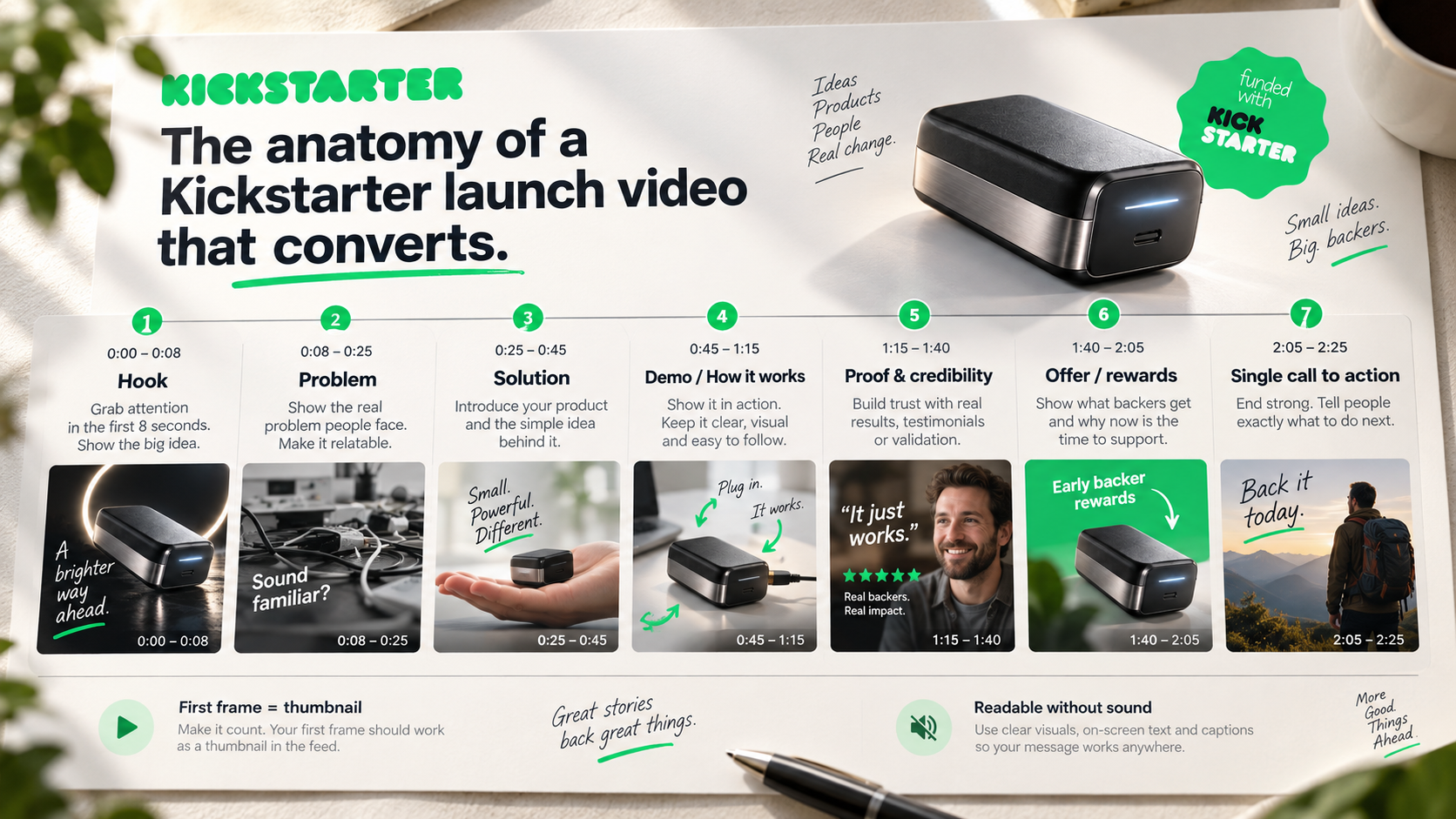
This is the structure we build against. It is not a formula for its own sake - each beat answers the question a backer is asking at that exact moment.
| Beat | Runtime | Job | Common mistake |
|---|---|---|---|
| Hook | 0:00-0:08 | Show the product in motion and show the problem, don't state it | Logo animation, agency card, slow fade-in |
| Tension | 0:08-0:25 | Name the specific frustration in the backer's own words | Generic pain that fits any product |
| Reveal | 0:25-0:50 | The product, named, with a one-sentence definition | Never plainly saying what it is |
| Three benefits | 0:50-1:25 | Three only, each with its own visual proof | A feature list read over B-roll |
| Credibility | 1:25-1:50 | Materials, tooling, prototype testing, specs | Claiming quality instead of showing it |
| The human beat | 1:50-2:10 | The founder, on camera, why this exists | A scripted CEO monologue, or nothing at all |
| The ask | 2:10-2:25 | Back the campaign, the early tier, the deadline | Ending on a logo with no instruction |
Total: two minutes to two and a half.
Why longer collapses
Past three minutes, two things happen at once. Completion rates fall, so fewer people ever reach the ask - and the ask is the only beat that converts. At the same time, the extra runtime is almost always spent on secondary features, which dilutes the three benefits you chose. A four-minute video does not tell backers more. It tells them the same thing less clearly, to fewer of them.
Why shorter usually means something got cut
Under ninety seconds, the beat that disappears is credibility. It is the least glamorous and the hardest to shoot, so it gets trimmed first. It is also the beat that answers the question that stops most pledges: will this actually ship? Cut the second colorway before you cut the tooling shot.
The first frame is a thumbnail
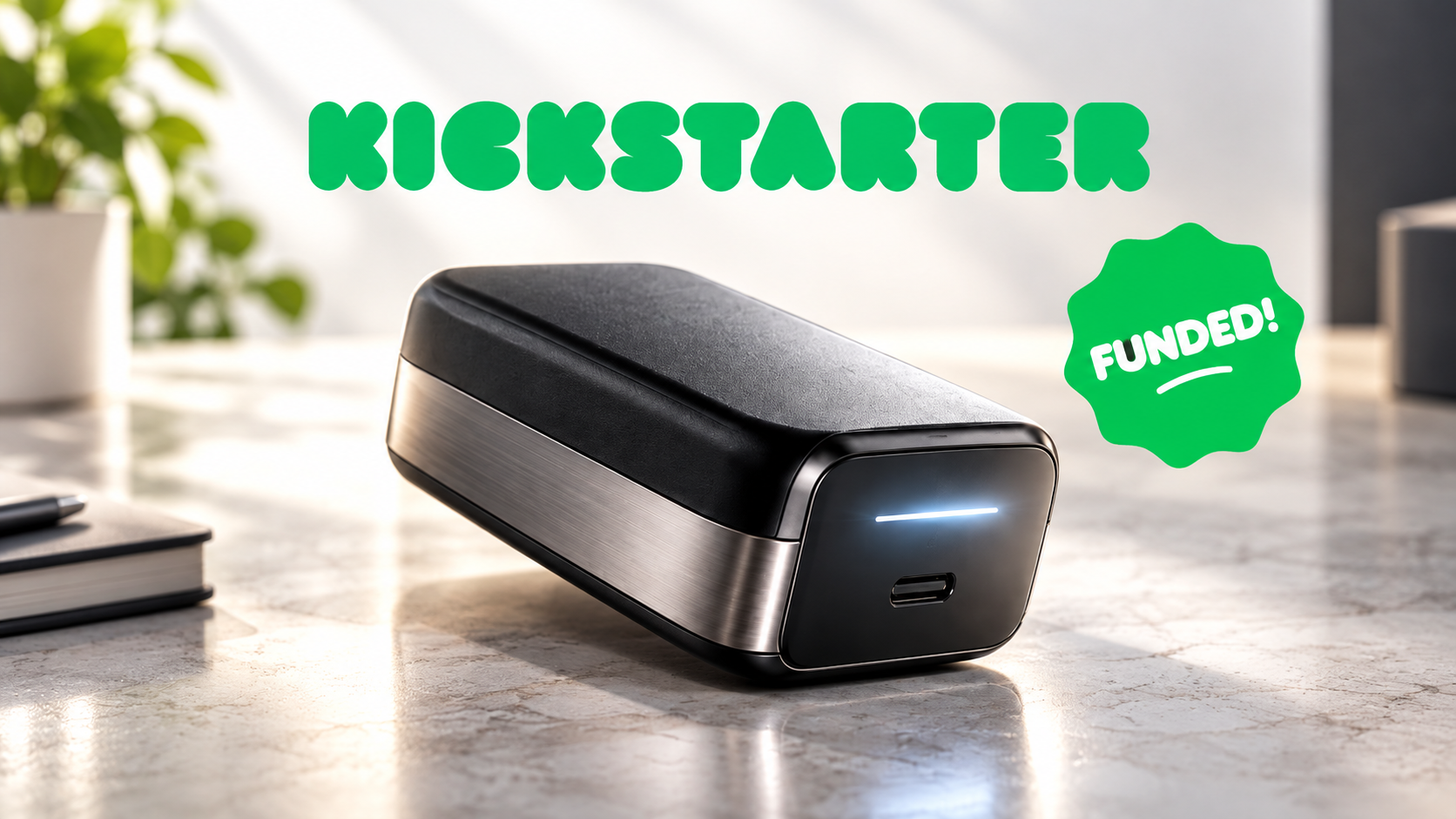
Your first frame is not just the start of the video. It is the still that appears in the Kickstarter grid, in shares, in press embeds, in your ads and in every screenshot anyone takes of your campaign. Treat it as a designed asset, not as the accidental by-product of where the edit begins.
Three rules that survive contact with reality:
- The product must be large in frame and readable at 200 pixels wide.
- Contrast must be high enough that the silhouette reads as a shape before anything else does.
- If there is text, it must be shorter than five words and larger than you think. Anything smaller than the product itself is decoration.
A useful test: shrink the frame to the size of a thumbnail on your own phone, hand it to someone who has never seen the product, and ask what it is. If they hesitate, the frame is not finished.
Sound off by default
Most first views are muted. Ads autoplay silent, people watch on trains and at desks, and the sound only arrives once someone has already decided to stay. So the video has to work twice: once as a silent visual argument, once with audio as a richer version of the same argument.
What that means in practice:
- Burned-in captions, not platform auto-captions, styled so they never sit over the product.
- Visual logic that survives muting: if the product's key benefit is only audible, it is invisible.
- Voiceover written to be redundant with the picture, not to carry information the picture lacks.
Music-only edits with no voiceover usually underperform, for one plain reason: without narration, the video shows what the product looks like but never says what it is for. Mood is not a value proposition. If you cannot afford a professional voice, record the founder - an honest voice beats an empty one.
Where CGI earns its place
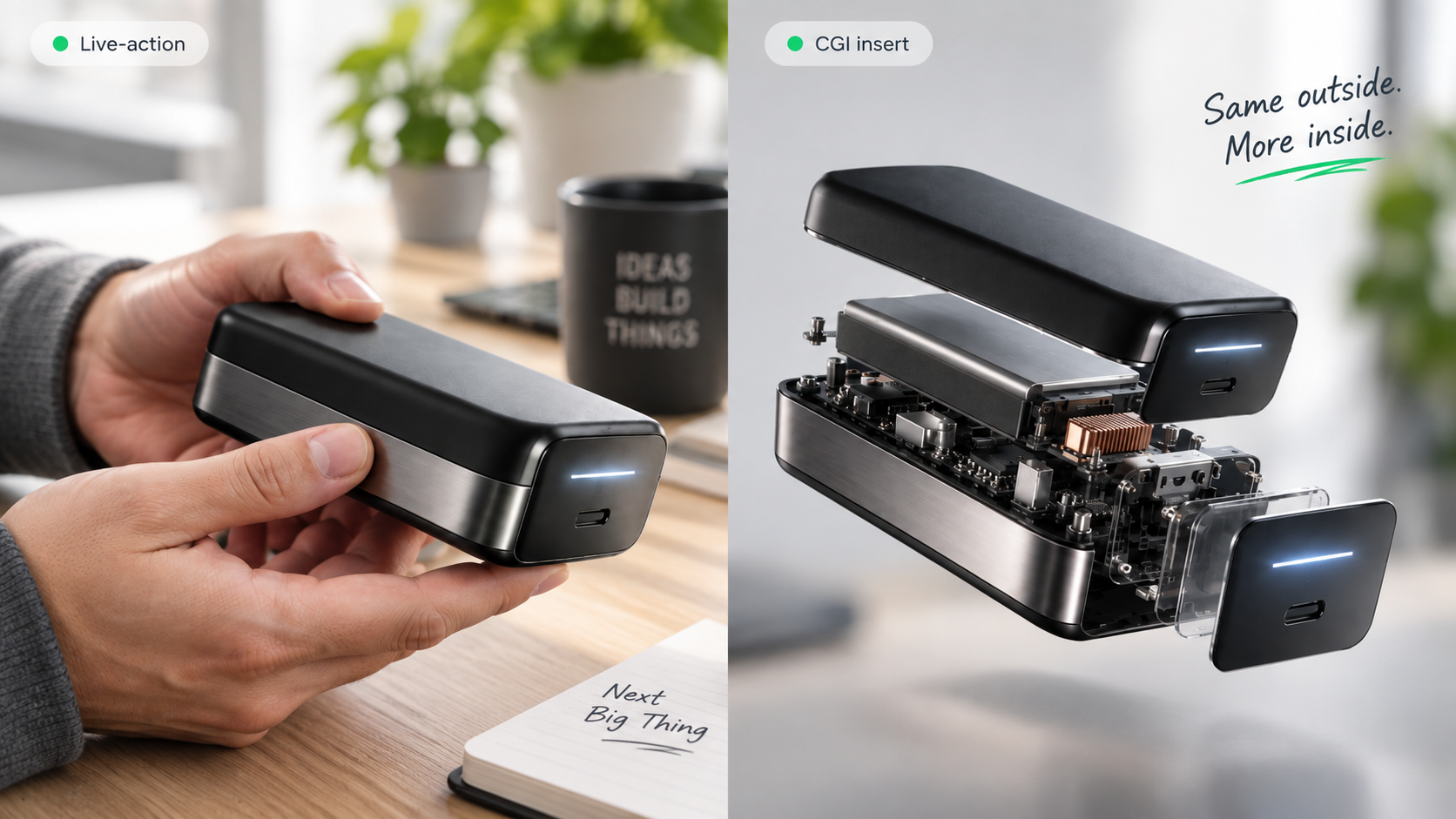
CGI is not a style choice in a launch film. It is the tool that makes beats three, four and five possible before mass production exists.
Use it for:
- Internals and exploded views - the mechanism, the layers, the engineering story.
- Scale comparisons, where the product sits next to something familiar.
- Finishes and materials that do not physically exist yet.
- Every colorway and configuration, rendered from one build in a single pass.
- Camera moves no rig could hold, used sparingly and with purpose.
Use live action for the human beat, always. Backers fund people. A rendered founder is not a founder, and no amount of photorealism buys the trust that a real face in a real room gives you for free.
The best campaign videos are hybrid. The decision is not CGI or footage - it is which shots belong to which technique.
For the full comparison, including cost and what you have to supply for each route, read our piece on CGI vs. live action for product launches.
Six ways campaign videos lose money
- An agency intro before the hook. Nobody pressed play to see a production company's logo. Every frame before the product is a frame spent on someone else's brand.
- A founder talking head as the opener. The founder beat is powerful in position six and weak in position one. Before a viewer knows what the product is, they have no reason to care who made it.
- A feature list instead of three benefits. Twelve features communicate nothing. Three benefits, each with a visual proof, communicate a product.
- No explicit call to action. "Back us on Kickstarter, early birds get X, the campaign ends on Y" converts. A logo over music does not.
- No sense of physical scale. Backers cannot judge size from a render on a black background. One shot with a hand, a desk or a doorway removes a doubt that otherwise sits there until they close the tab.
- Music fighting the voiceover. If the mix makes the narration work to be heard, the narration loses. Duck the music, or drop it under the key lines entirely.
How to know before you launch
You do not have to guess which hook works. You can buy the answer cheaply, before the video is locked, by running the competing hooks as paid creative during pre-launch and reading which one earns attention and leads - the method we lay out in creative testing before launch. Then place that winning hook in the first eight seconds of the film and at the top of the campaign page.
The other half of knowing is scheduling. The video has to be locked before the email warm-up starts, which means production has to start further back than most founders plan for. Our pre-launch timeline works backwards from launch day so the film is never the thing holding the date.
One note on numbers. We have deliberately not quoted completion rates or view-through benchmarks in this article. The figures that get passed around online are usually uncited, and averages across all of Kickstarter tell you very little about a hardware campaign in your category. When we do publish benchmarks, they will come from our own campaigns.
[Data placeholder - to supply: our internal view-through and completion figures across recent launches, to replace the qualitative statements in this section.]
What the beats look like when the product is boring
Not every product has a mechanism to reveal. Software, accessories, consumables and simple redesigns all have to earn attention with the same seven beats and less spectacle. The structure does not change; the emphasis does.
For a product with little visual drama, the tension beat carries the film. You spend longer establishing the frustration, in a real situation, with real hands, so that the reveal lands as relief rather than as novelty. The three benefits become three specific outcomes rather than three features. And the credibility beat shifts from tooling and materials toward evidence of use: how many people tested it, for how long, and what they stopped doing as a result.
A second adjustment: comparison. When a product looks similar to what already exists, the film has to show the difference on screen, side by side, at the moment the claim is made. Saying "quieter" does nothing. Showing the meter, or the two objects in the same frame doing the same job differently, does the work.
The edit decisions that matter most
Three choices inside the edit change performance more than anything in the shoot.
Where the first cut lands. A hook that holds one shot for six seconds asks for patience. Two or three cuts inside the first eight seconds signals pace and gives the viewer a reason to stay for the next one.
Whether the product is named early. Say the product's name and its one-line definition before the fifty-second mark. Films that withhold the name for dramatic effect lose the viewers who never find out what they were watching.
Where the ask actually sits. Put it at the end, and repeat the offer in the caption and on the page. A single unrepeated call to action at 2:20 reaches only the people who watched to 2:20.
What to hand your editor
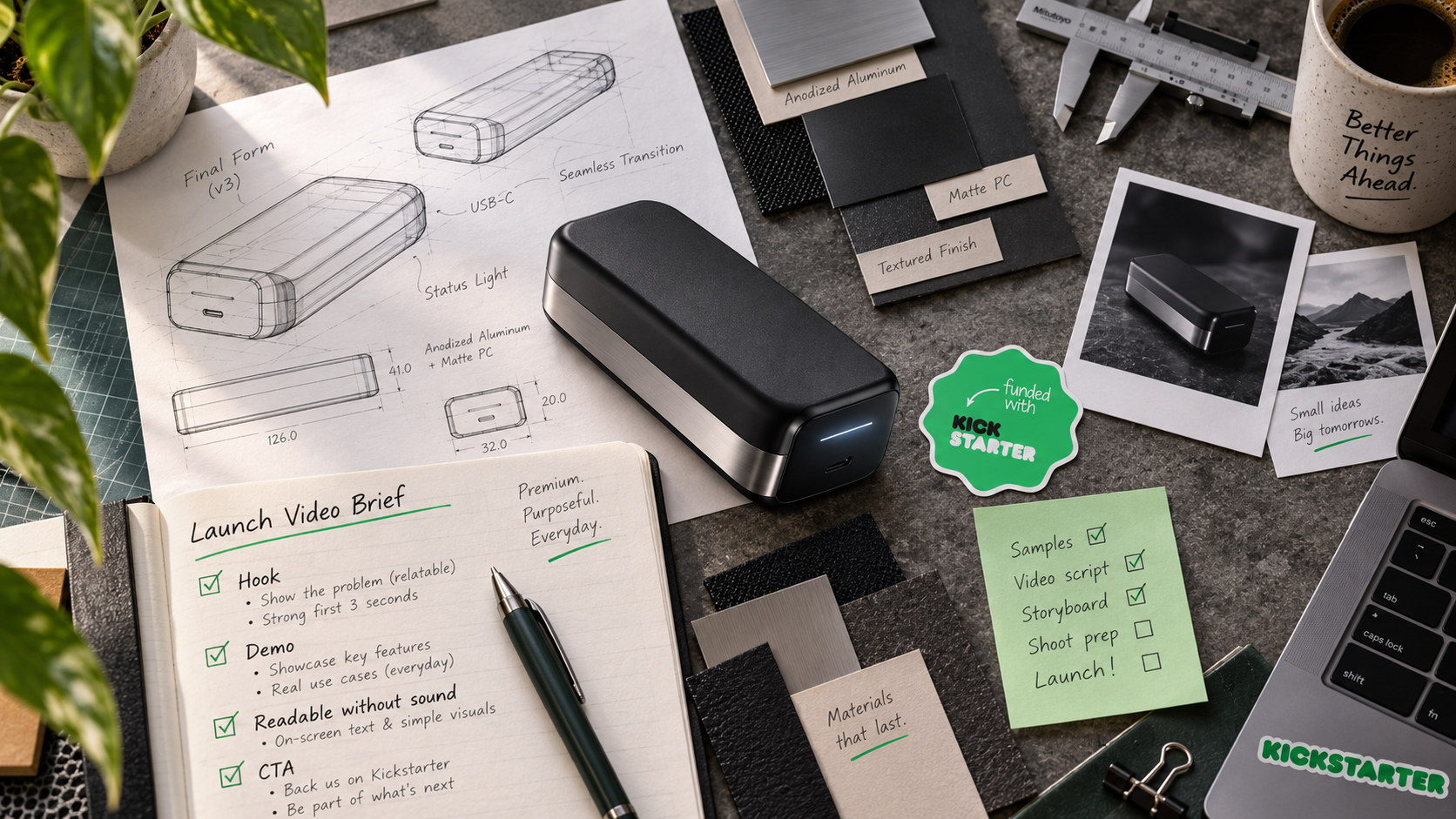
You will get a better film faster if you arrive with these things ready: the tested hook line, the three benefits in priority order with the visual proof for each, the specifications you are willing to state publicly, the tooling and manufacturing status, and one named decision-maker who can approve a cut. That last item shortens schedules more reliably than any creative decision.
Frequently asked questions
How long should a Kickstarter video be?
A Kickstarter video should run between two minutes and two and a half minutes. That length fits all seven beats a backer needs - hook, tension, reveal, benefits, credibility, founder, ask - without asking for attention nobody has agreed to give. Past three minutes, completion drops sharply and the ask arrives after most viewers have left. Under ninety seconds, something important has usually been cut, and it is almost always the credibility beat.
Do I need a video to launch on Kickstarter?
You need a video to launch a hardware or design product on Kickstarter, because a page without one asks a stranger to trust a still image and a paragraph. The video is where the product moves, where scale becomes obvious and where a founder becomes a person. A modest video with a clear hook and a real founder beat outperforms no video by a wide margin, and it outperforms an expensive video with no structure.
Should the founder appear on camera?
The founder should appear on camera for roughly thirty seconds, placed after the credibility beat and before the ask. Backers are funding a promise of future delivery, and that promise is easier to believe when it comes from a face. The founder beat does not need a studio - a quiet room, good light, clean audio and one honest reason the product exists will do more than a polished script read badly.
CGI or real footage for a crowdfunding video?
Most crowdfunding videos should use both, with CGI carrying the reveal, the benefits and the engineering proof, and real footage carrying the founder and any moment involving hands, faces or environments. CGI is the only option when no prototype exists, and it is the cheapest way to show internals, colorways and scale. Footage is what proves the object exists in the world. The choice is per shot, not per project.