
A week-by-week pre-launch plan for crowdfunding: audience building, asset deadlines, ad testing windows and what has to be done before day one.
Contents10 sections
- 01Campaigns are won before they open
- 02Three workstreams, one calendar
- 03Week by week
- 04The math you should do before you commit
- 05Launch day, hour by hour
- 06What to do when you're already late
- 07Who does what
- 08The five things that break schedules
- 09A pre-launch definition of done
- 10What we hold inside this schedule
Campaigns are not won during the campaign. They are won in the three months before the page goes live, in a set of tasks that almost nobody finds exciting.
Campaigns are won before they open
Day-one funding comes from an audience you already built. That is the entire mechanic. Kickstarter's own discovery surfaces reward early traction, so a campaign that opens strong gets shown to more people, which makes it stronger. A campaign that opens flat spends its remaining days trying to buy back momentum with paid traffic at a much worse rate.
Launching to strangers is the single most common cause of a flat first forty-eight hours. Not a weak product, not the wrong price - just an empty room at the moment the doors open.
So the work of pre-launch is simple to state and hard to do: gather a warm, qualified audience, and have the creative ready early enough that you can use it to gather them.
Three workstreams, one calendar
Pre-launch has three parallel tracks, and confusing them is where schedules break.
Audience. Landing page, lead ads, email nurture, reservation funnel, communities, press. This track needs the most calendar time because attention accumulates slowly.
Assets. CGI, film, stills, ad cutdowns, page visuals. This is the long pole. CGI needs modelling and look development before anything is even viewable; a shoot needs a date that cannot be moved.
Page. Copy, structure, layout, reward tiers, risks section, platform approval.
The tracks depend on each other in one direction: assets feed audience, and both feed the page. Which is why the most common planning error - starting creative once the ad budget is already booked - stalls all three at once.
Week by week
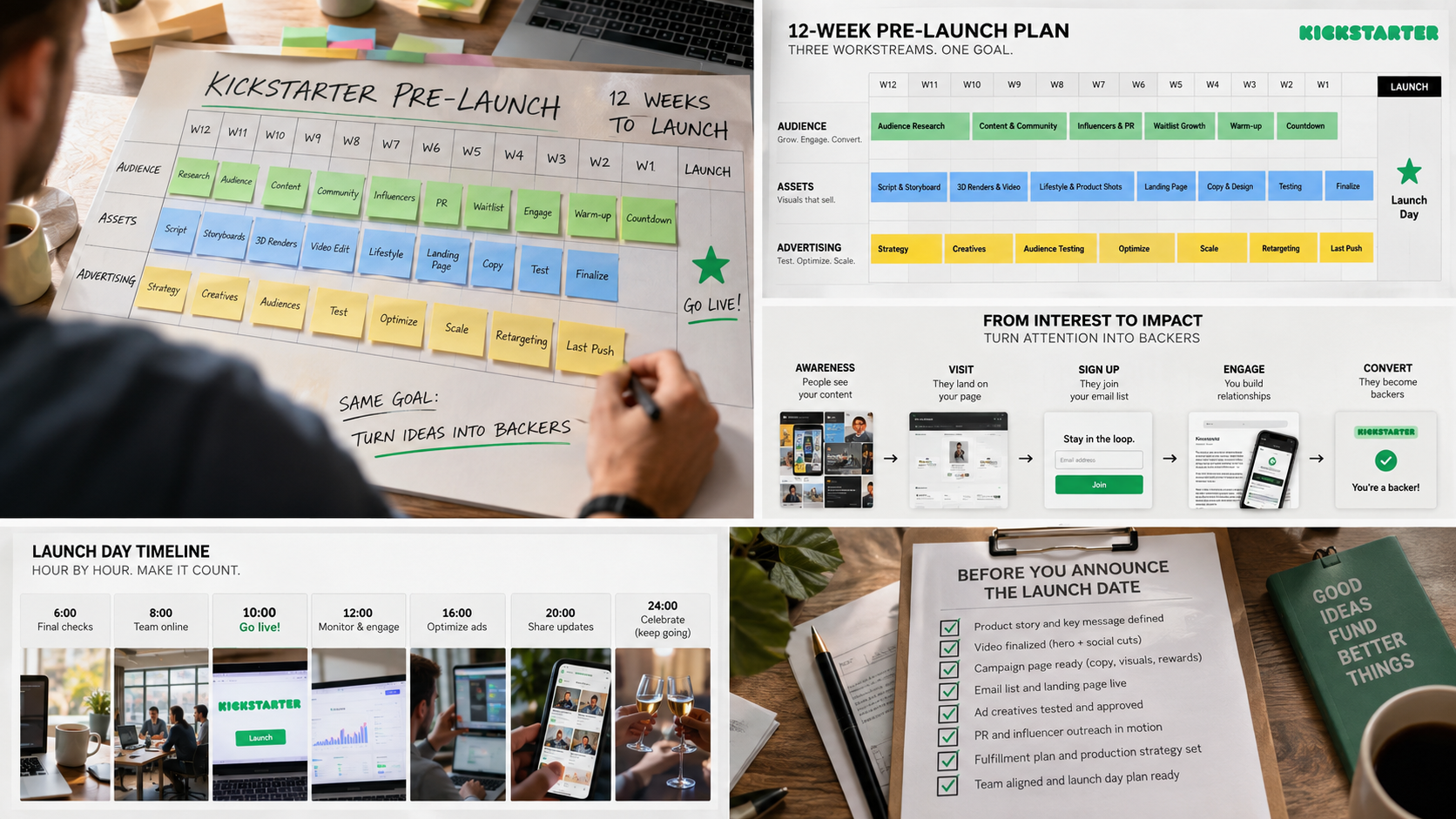
The table below is the plan we work backwards from. T-12 means twelve weeks before launch day.
| Week | Audience | Assets | Page |
|---|---|---|---|
| T-12 to T-10 | Landing page live with email capture; positioning and price testing | Product in CAD or prototype photographed; references gathered | Positioning and core promise drafted |
| T-10 to T-8 | Ad account, pixel, first audience tests | CGI production starts | Section order mapped |
| T-8 to T-6 | Lead-gen ads running; cost per lead measured | Video shoot or CGI animation | Copy drafted against the tested promise |
| T-6 to T-4 | Reservation funnel opens with the low-deposit VIP step | Video edit and revisions | Page copy and layout drafted |
| T-4 to T-2 | Reservations scaled; press and community outreach | Final stills, ad cutdowns, page visuals delivered | Page assembled with final assets |
| T-2 to T-0 | Email sequence written and scheduled; launch-day war room planned | Vertical cutdowns and thumbnails finished | Page review and platform approval |
Two things about this table are load-bearing. The landing page is live in the very first block, because nothing else in the audience track can start without somewhere to send traffic. And the video is locked by T-4, because the page, the email sequence and the ad refresh all get built on top of it.

The math you should do before you commit
Before you commit to a date, do the arithmetic. It is not a promise, it is a planning tool, and it takes two minutes.
Day-one funding = leads x conversion rate x average pledge.
An illustrative example, with numbers you should replace with your own:
- 4,000 email leads
- 5% convert on day one
- $180 average pledge
- 4,000 x 0.05 x $180 = $36,000 on day one
Now run it again at 2% and at 8%. If the low case does not clear your funding goal, you either need more leads, a higher average pledge, or a better-qualified list - and you need to know that now, not on launch morning.
Conversion rates vary enormously by category, price point and traffic quality, so treat the middle number as the one you are least sure about.
Why deposits predict better than emails
A plain email list costs a click. A reservation - a small refundable deposit for a place in the early tier - costs a decision. The people who make that decision have already crossed the psychological line that day one asks them to cross, so they convert at a much higher rate and they tell you something an email address cannot: that the price is acceptable.
If you only have time to build one thing, build the reservation funnel.
Launch day, hour by hour
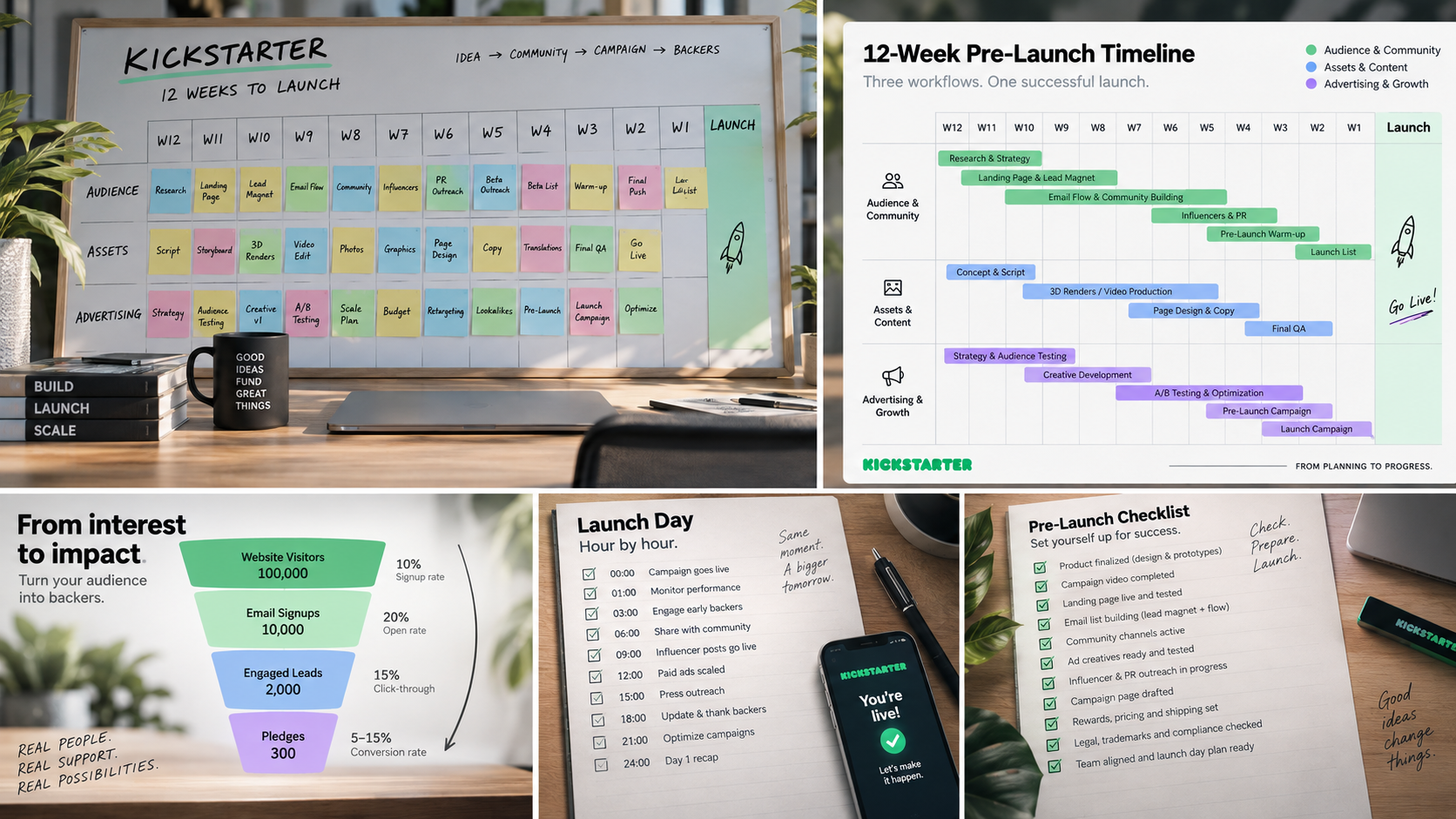
The first twenty-four hours are choreography, not improvisation.
- Hour 0. Page goes live. Email one goes to reservation holders only, with the direct link to their tier.
- Hour 1-2. Email two to the full list. Reservation holders are excluded so nobody gets two versions of the same message.
- Hour 2-4. Communities and personal networks. Not spam - the places you have actually been present in for the past two months.
- Hour 4-8. Watch pledge-per-visitor rather than raw traffic. Traffic tells you the ads work; pledge rate tells you the page works.
- Hour 8-12. Second push to non-openers with a different subject line. Press follow-ups.
- Hour 12-24. Retargeting live for page visitors who did not pledge. First social proof update posted.
One rule for the team: do not rewrite the page in the first six hours. Early numbers are noisy and panicked edits usually make the page worse. If the pledge rate is still weak after a full day of real traffic, then change one thing - almost always the top of the page - and measure again.
What to do when you're already late
Six weeks out with nothing built is a common place to be. Here is the compressed version.
- Weeks 1-2. Landing page and CGI or film production start in parallel. No exceptions.
- Weeks 3-4. Ads live for lead generation. Reservation funnel opens as soon as there is one strong asset to run.
- Weeks 5-6. Page assembled, email sequence written, approval submitted.
What gets cut: the wide creative test matrix, the long nurture sequence, the press outreach, the secondary colorway renders. What never gets cut: the first eight seconds of the video, and the reservation funnel. One is the reason people watch; the other is the reason day one is not empty.
If you want the shot-by-shot logic of the film that sits inside this schedule, read the anatomy of a launch video. If you want to know which hook to build it around, that answer comes from creative testing.
Who does what
A pre-launch has four jobs, and on small teams two of them get quietly forgotten.
The owner of the date. One person holds the launch date and says no to anything that threatens it. Usually the founder.
The owner of the audience. Landing page, ads, email, reservations, communities. This role needs daily attention, not weekly.
The owner of the assets. Briefs the studio, supplies CAD and samples, consolidates feedback into one voice, approves cuts. When five people send notes separately, the schedule slips.
The owner of the page. Copy, structure, tiers, risks, approval submission. This is the job that is always underestimated, because the page looks like it can be written in a weekend and cannot.
If one person is doing three of these, cut scope somewhere before week one rather than discovering the collision at T-3.
The five things that break schedules
- Product changes after CGI starts. Every geometry change is re-modelling. Freeze the industrial design before production begins, or accept the cost of not doing so.
- Missing or unusable CAD. Rebuilding a model from photographs adds weeks and small inaccuracies.
- Feedback by committee. Consolidated notes, one round, one voice. Open-ended revision cycles are the most common cause of a late film.
- Platform approval left to the end. Review takes time and can come back with changes.
- No decision-maker available. A week of waiting for an approval is a week of the calendar gone.

A pre-launch definition of done
Before you commit publicly to a date, you should be able to answer yes to all of these: the landing page is live and collecting emails; one strong creative asset exists and is running; cost per lead is known; the reservation funnel is open; the film is locked; the page is assembled with final assets; the email sequence is written and scheduled; platform approval is granted; and the day-one arithmetic clears your funding goal at the pessimistic conversion rate, not the optimistic one.
Anything still open on that list is a risk you are carrying into launch week, and launch week has no slack in it.
What we hold inside this schedule
Our part of the calendar is the asset track: the film, the CGI, the renders and the page visuals your team or the platform's editor drops into the page. We shoot live action, build in CGI, and combine both in one frame when the story needs it - see cinematic launch videos and the Oakley Meta Vanguard study for what that output looks like.
Frequently asked questions
How long does a Kickstarter pre-launch take?
A Kickstarter pre-launch takes about twelve weeks when the product is ready to be photographed or exists in CAD. Roughly the first four weeks go to positioning, the landing page and the start of CGI production; the middle four to producing the film and testing ads; the last four to the reservation funnel, the campaign page and platform approval. Compressed six-week versions are possible, but they trade away testing time, which is the cheapest part of the plan.
How many email subscribers do I need before launching?
There is no universal subscriber number, because day-one funding depends on list quality far more than list size. A useful way to plan is arithmetic rather than a benchmark: subscribers multiplied by an expected conversion rate multiplied by average pledge gives a day-one estimate you can sanity-check. A smaller list built from deposit-paying reservations will normally outperform a much larger list collected with a giveaway.
When should I start producing the video?
Video production should start around ten weeks before launch, because the film has to be locked before the email warm-up and the final campaign page are built on top of it. CGI needs modelling and look development before anything is viewable, and live action needs a shoot date that cannot move. Starting later does not compress the work - it just moves the risk onto launch week.
Can I launch without a pre-launch campaign?
You can launch without a pre-launch campaign, but you will be launching to strangers, and a flat first forty-eight hours is the most common result. Kickstarter rewards early momentum with visibility, so campaigns that open with a warm audience keep compounding while cold launches spend their whole run trying to recover. If time is short, build the reservation funnel even if you skip everything else.