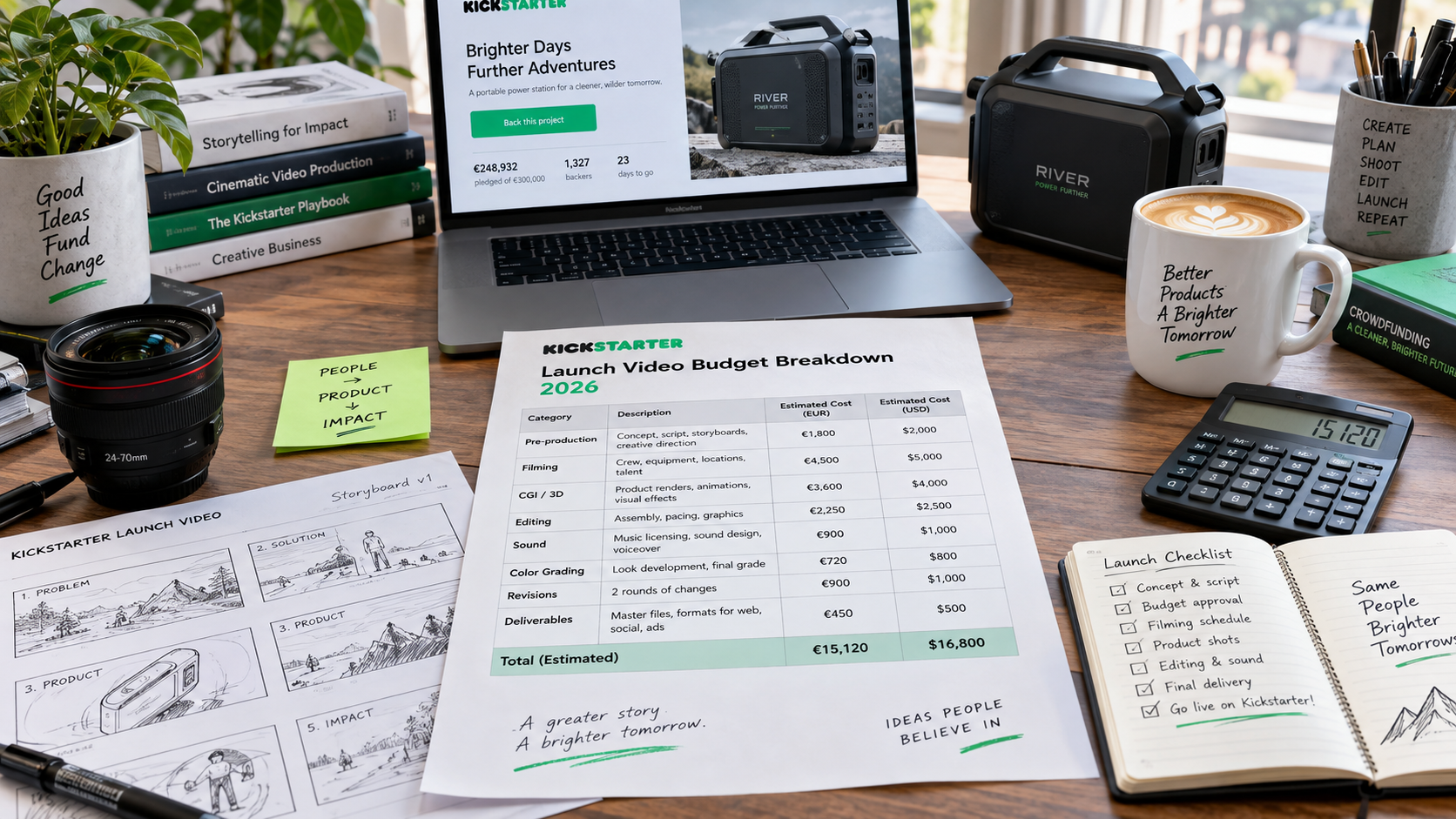
Real price ranges for crowdfunding videos, what drives the number, and how to tell which tier your campaign actually needs.
Contents10 sections
- 01The tiers
- 02What actually drives the price
- 03The cheap options, and when they're the right call
- 04The hidden costs founders forget
- 05How the video budget relates to the campaign budget
- 06Red flags in a quote
- 07A cost estimator we're considering
- 08How to compare two quotes properly
- 09What we ask before quoting
- 10Where founders should spend more, and where less
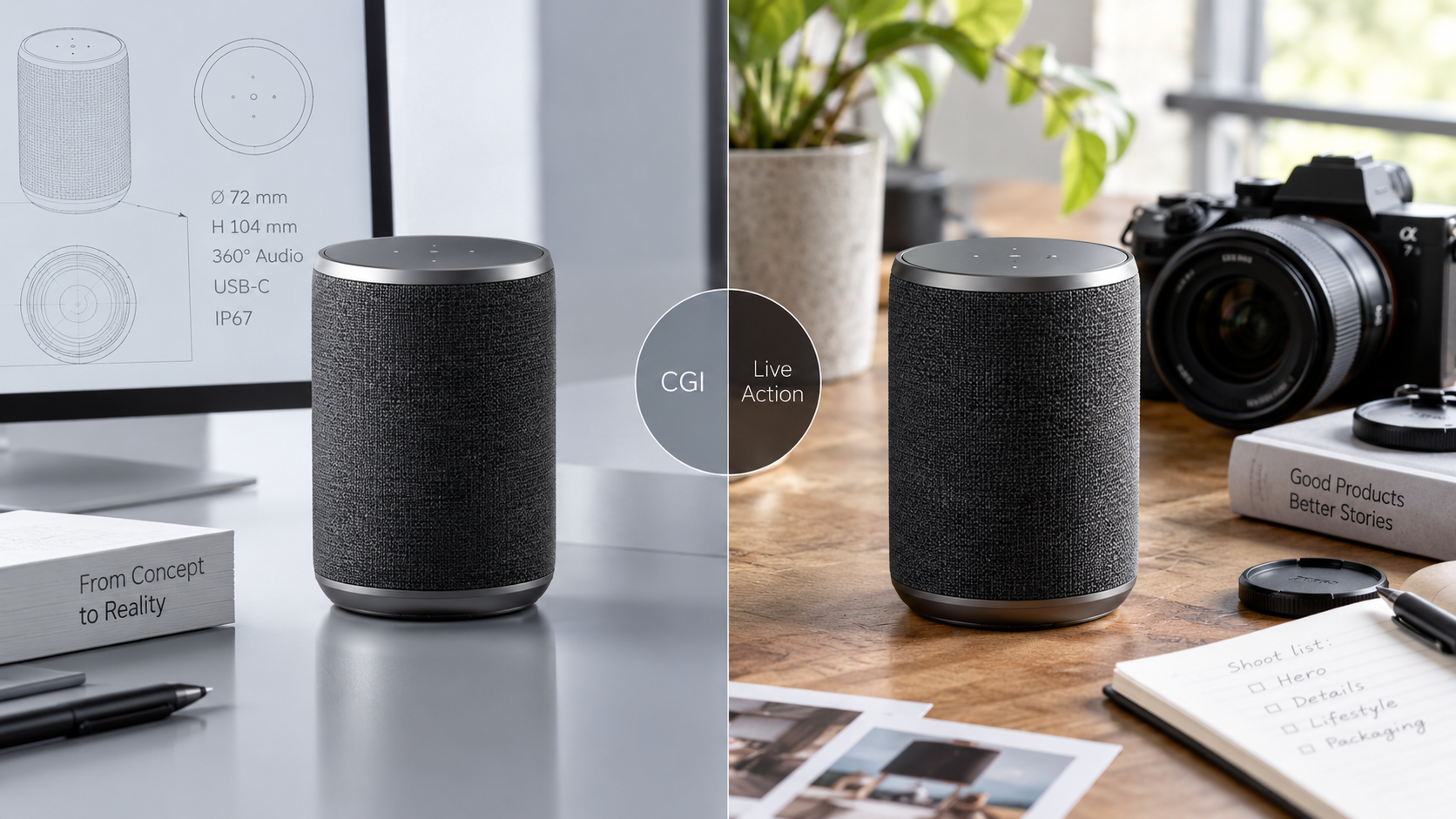
A crowdfunding video's price is driven by three things: how many finished seconds you need, whether the product has to be built in CGI or can be filmed, and how many extra cuts the campaign needs. Templated edits assembled from footage you supply sit at the bottom of the market. A freelance videographer with a working prototype sits in the middle. A studio production combining photoreal CGI, a live-action founder beat and a full set of ad cutdowns sits at the top, and it is the only tier that can show a product that does not physically exist yet. Which tier you need is decided by your product, not by your ambition.
The tiers
[Data placeholder - to supply: our real price ranges for each tier below, plus the ranges we typically see quoted for tiers one and two. Until supplied, this table describes scope only and states no figures.]
| Tier | Typical range | What you get | Who it's right for |
|---|---|---|---|
| Solo editor / template | To supply | An edit assembled from footage and stills you provide, music, basic titles, one or two revision rounds | Simple products with existing footage and a tight budget |
| Freelance videographer | To supply | A shoot day, a founder interview, product B-roll, an edit and captions | Finished products that photograph well and need human credibility more than engineering proof |
| Small production studio | To supply | Scripting, a directed shoot, motion graphics, some 3D, a few cutdowns, structured revisions | Products with a clear story and a working prototype |
| Full agency production with CGI | To supply | Concept and script, storyboards, photoreal CGI hero and internals, live action founder beat, full ad and vertical cutdown set, art direction across page and ads | Pre-production hardware, complex mechanisms, campaigns where the launch has to carry a real funding target |
The honest ceiling of each tier matters as much as its price. A templated edit cannot invent a product that has not been manufactured. A single shoot day cannot show you what is inside a sealed device. A studio CGI production can do both, and it costs accordingly.
What actually drives the price
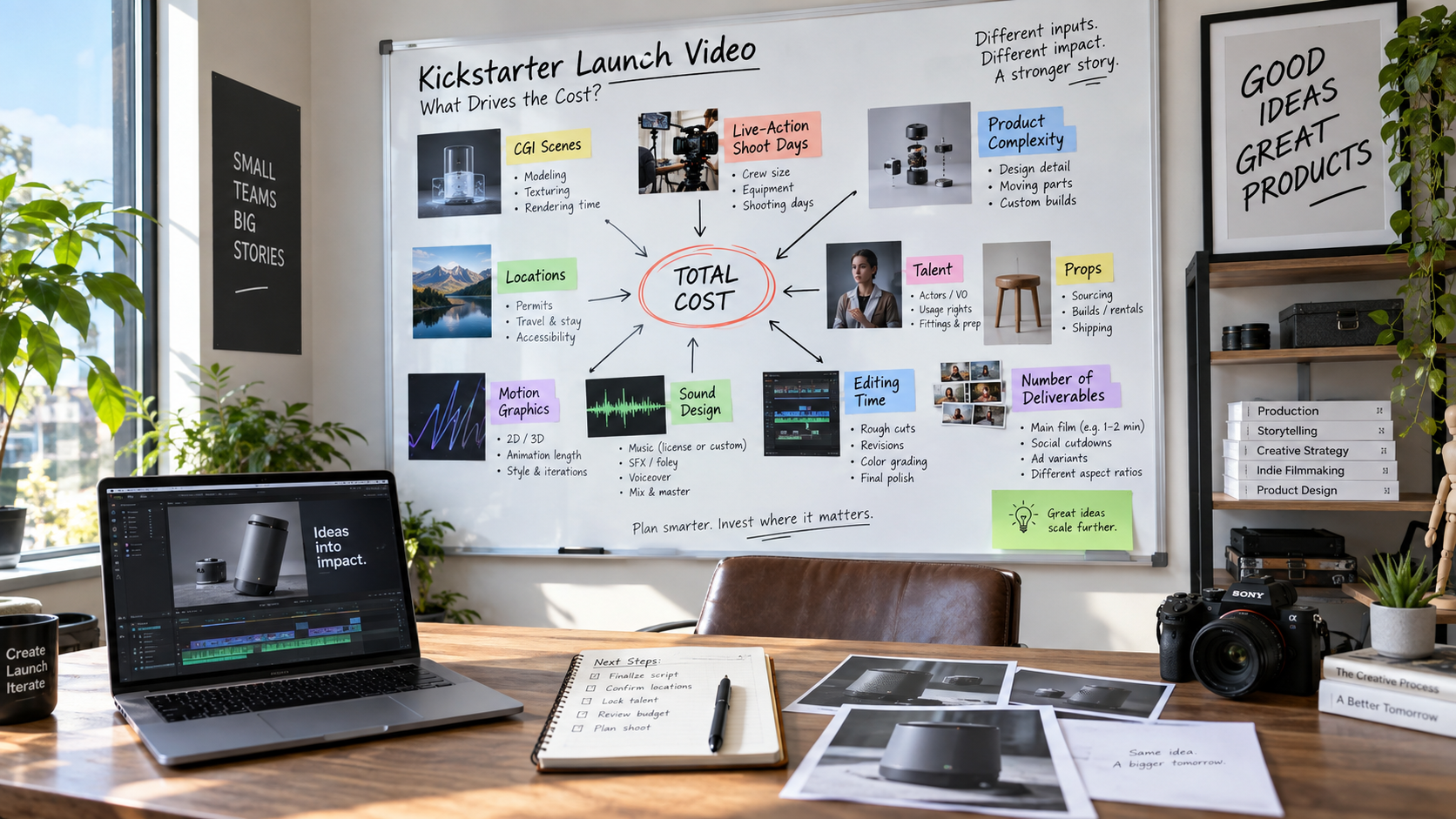
- Finished seconds. Not shoot days, not render hours - the length of what you keep. Every additional twenty seconds of finished CGI is real modelling, animation and rendering work.
- CGI complexity. How many hero assets, whether internals have to be modelled, how much animation there is, and how technical the materials are. A single matte plastic object is a different job from a machined assembly with glass and brushed metal.
- Whether a prototype exists. With a physical unit, some shots can be filmed cheaply. Without one, everything visual has to be built.
- Live action crew days and location. Crew, kit, location and the logistics around them are priced by the day and do not compress.
- Talent and usage rights. Hiring people costs money once. Using their image in paid ads, in more territories, for longer, costs more.
- Voiceover and music. A professional voice and a properly licensed track are modest line items. Licensing scope - paid social, worldwide, perpetual - is where the number moves.
- Number of cutdowns. The launch film is one deliverable. Six vertical ad variants, a fifteen-second teaser, page loops and thumbnails are another, and they are usually where founders under-budget.
- Revision rounds. Two structured rounds is normal. Open-ended feedback is the single most reliable way to make a project cost more than it should.
The cheap options, and when they're the right call
A low budget is genuinely the right answer in one situation: the product is easy to understand at a glance, a working unit exists, and the founder is compelling on camera. A clear phone-shot demonstration with clean audio and honest narration can fund a campaign, and it has.
What you lose is the ability to argue visually. No internals, no exploded views, no colorways, no scale control, no engineering proof. If your product's value is inside it - a mechanism, a material, a piece of tooling - a cheap video will simply not be able to say what your product is, at any length.
The hidden costs founders forget
- Ad cutdowns and vertical versions, usually needed in more variants than planned.
- Thumbnails and page stills, which are a separate deliverable from the film.
- Reshoots or re-renders when the product changes during production.
- Music licence scope upgrades once you start spending on paid social.
- Rush fees when the launch date moves toward you rather than away.
- Translation, subtitling and localisation for non-English markets.
How the video budget relates to the campaign budget
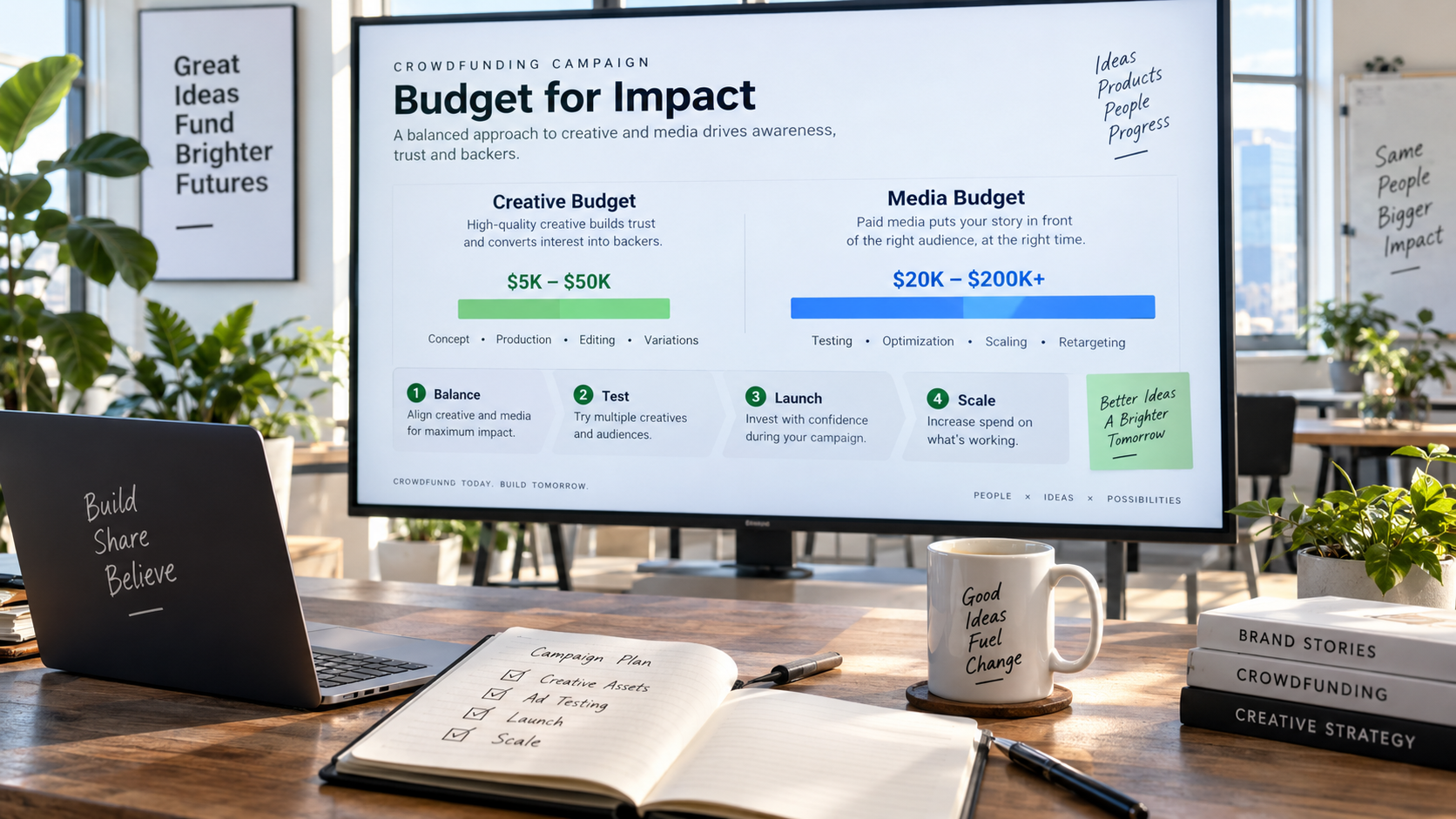
The video is one line inside a launch budget that also contains ads, the campaign page, the pre-launch funnel and eventually fulfilment. The useful framing is not a ratio - anyone quoting a universal percentage is guessing - but a sequence of questions.
Can you fund the ads that will make the video seen? A brilliant film with no traffic behind it does nothing. Does the video have to carry engineering credibility, or can the page carry it? Will these assets be reused after the campaign for a store and evergreen ads, in which case the cost amortises across a year rather than a month?
That last question changes the arithmetic more than any other, and it is the subject of the post-campaign playbook.
Red flags in a quote
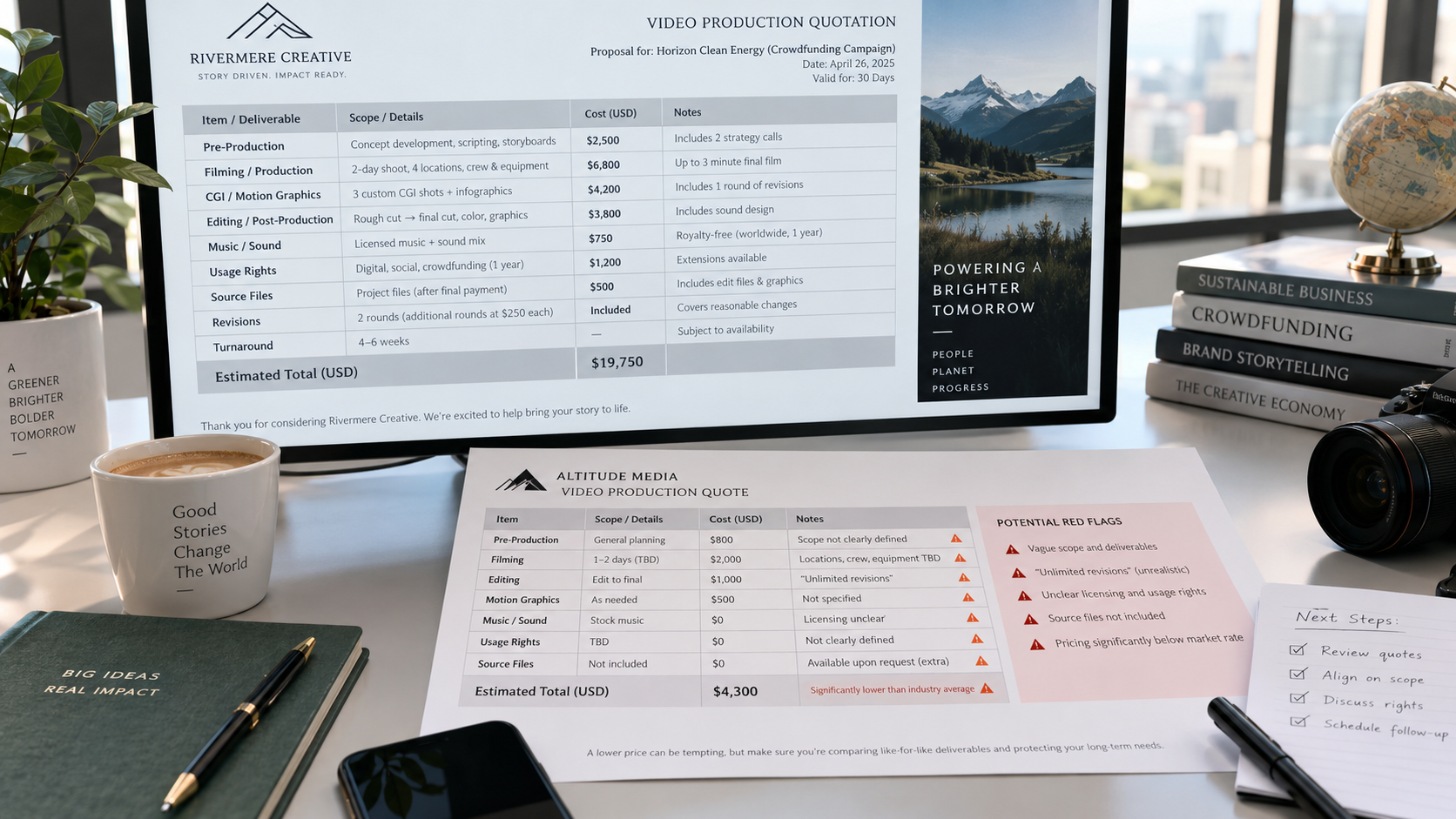
- No scope document. A price without a defined deliverable list is not a quote.
- No stated revision count. This is where budgets quietly double.
- No ownership or licensing terms. Ask specifically about the 3D assets and the music.
- CGI promised without asking for CAD. Anyone who quotes photoreal CGI before seeing your files has not looked at the actual job.
- A timeline that ignores platform approval. Kickstarter review takes time, and a schedule that ends on launch day is a schedule that will slip.
- A quote that matches your budget exactly, with no questions asked first. Scope should determine price, not the reverse.
A cost estimator we're considering
We are thinking about building a small estimator on this site so founders can get a defensible range in under a minute. The inputs would be: seconds of finished video, CGI required yes or no, physical prototype available yes or no, and number of ad cutdowns. The output would be a range with a plain-language explanation of which inputs moved it, plus a prompt to request a scoped quote.
To build it properly we would need our own price bands per tier, the multipliers we actually apply for CGI complexity and cutdown volume, and a decision on how visible the numbers should be publicly. It would live on its own page, feed the contact form with the selected inputs, and take a short focused build. Say the word and we will scope it separately.
How to compare two quotes properly
Two quotes for "a Kickstarter video" are almost never quotes for the same thing. Normalise them before you compare the numbers, using five questions.
How many finished seconds, and how many separate deliverables? One 2:15 film, or one film plus six verticals plus a teaser plus page loops?
How much of it is CGI, and how many hero assets? One product, or a product plus accessories plus a packaging render?
How many revision rounds, and what counts as a round? A round should be one consolidated set of notes, not one note.
Who owns what afterwards? Delivered videos, project files, 3D models and materials are four separate questions.
What is assumed from you? CAD files, samples, a shoot location, talent, brand assets. Anything assumed and not supplied becomes a change order.
Once both quotes answer those five questions, the cheaper one is often the more expensive one.
What we ask before quoting
For context, this is what we need in order to give a number rather than a range: what the product is and its current stage, whether CAD exists, the launch date, the platform, the list of deliverables including ad cutdowns, whether a founder beat is wanted, the languages required, and the funding target. The target matters because it tells us what the film has to be capable of carrying commercially.
With that, a scoped quote is a short job. Without it, any figure is a guess, and guesses in this business are always wrong in the same direction.
Where founders should spend more, and where less
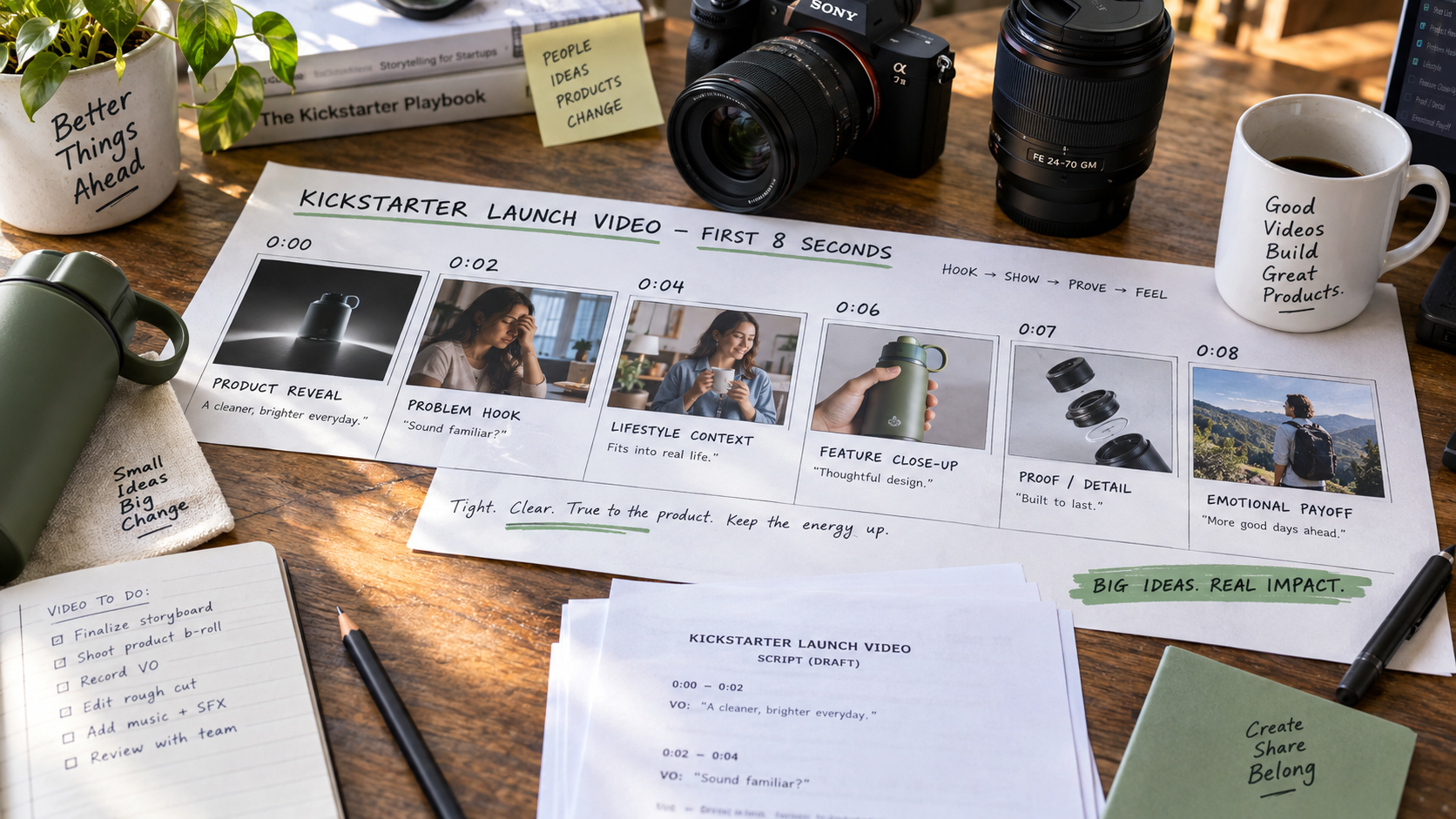
Spend more on: the first eight seconds, the credibility beat, and the number of ad cutdowns. Those three have the most direct relationship to money raised.
Spend less on: extra colorways nobody has ordered yet, licensed music at premium tiers, second locations, and total runtime. Long films are more expensive to make and less effective to watch.
Do not economise on: captions, sound mix and the thumbnail frame. They are the cheapest line items on the invoice and they are visible in every single view.
Frequently asked questions
How much does a Kickstarter video cost?
A Kickstarter video's cost is set by four things: how many finished seconds you need, whether the work is CGI or live action, whether a physical prototype exists, and how many extra cuts the campaign needs for ads. Templated edits made from supplied footage sit at the bottom of the market, freelance shoots in the middle, and full studio productions with photoreal CGI at the top. Ask any studio for a scope document before comparing numbers, because two quotes rarely describe the same deliverable.
Is a cheap crowdfunding video worth it?
A low-budget crowdfunding video is worth it when the product is simple to understand, a working unit exists to film, and the founder is genuinely good on camera. In that situation, clarity matters more than polish and a modest video will outperform no video by a wide margin. It stops being worth it when the product's value lives inside it, because internals, mechanisms and materials cannot be explained with a phone and a tripod.
How long does production take?
Production time depends on route. CGI needs modelling and look development before anything is viewable, so the first weeks produce no visible output and then everything appears at once. Live action is quick to prepare and then fixed to a shoot date that cannot move. Either way, plan for the video to be locked around four weeks before launch, because the campaign page, the ad cutdowns and the email sequence are all built on top of it.
Do I own the footage and the 3D assets?
Ownership has to be stated in the contract, and it varies more than founders expect. Final delivered videos are usually licensed or assigned to the client, while project files, 3D models and rigs are often retained by the studio unless the agreement says otherwise. If you intend to reuse the 3D model for future ads, packaging or a Shopify store, ask for the model and its materials explicitly, in writing, before the project starts.